Cet article est offert en anglais seulement pour le moment.
Every finance app asks something of you. We built one that asks nothing.
We mapped Wellthplan against Monarch, YNAB, Rocket Money, Cleo and Albert across 74 features. Here is what the market looks like in September 2026 — and why the household is the ground nobody else is standing on.
Most finance apps help you manage money. Wellthplan helps you stop thinking about it.
That line has been our thesis since the beginning, and this month we finally put it to the test properly. We built a competitor matrix — 74 features, ten categories, five apps we respect — and then we did the uncomfortable part: we went and read everyone's pricing pages and changelogs to see how much of our story still holds.
Here is what we found.
Every app makes you a deal
If you step back from feature lists, the personal-finance market sorts itself into four corners, based on two questions: does the app do the thinking for you, or do you do it? And does it wait for you to open it, or does it come to you?
- Learn a system. YNAB and EveryDollar ask you to adopt a method and work it every week. It genuinely changes lives — for the people who keep doing the work. YNAB itself says it best: "You're bad at money (but not a bad person)." It's a course, and courses have homework.
- Build a dashboard. Monarch and Copilot give you the most beautiful instrument panel in the category, and they ship monthly — forecasting, treemap reports, a Plus tier for retirement modelling. But an instrument panel only tells you things while you are looking at it.
- Fix your bills. Rocket Money's moat is cancelling subscriptions and negotiating bills. It is real money back, and it is the reason people love the app. It is also a reason to open the app less, not more.
- Be a bank. Albert and Cleo give you cash advances, a debit card, early paycheck, a savings account. Once you hold someone's deposits, you are a bank first and an advisor second.
Each of these is a good deal for someone. But every one of them asks you for something: your discipline, your attention, your tolerance for a dashboard, or your paycheck.
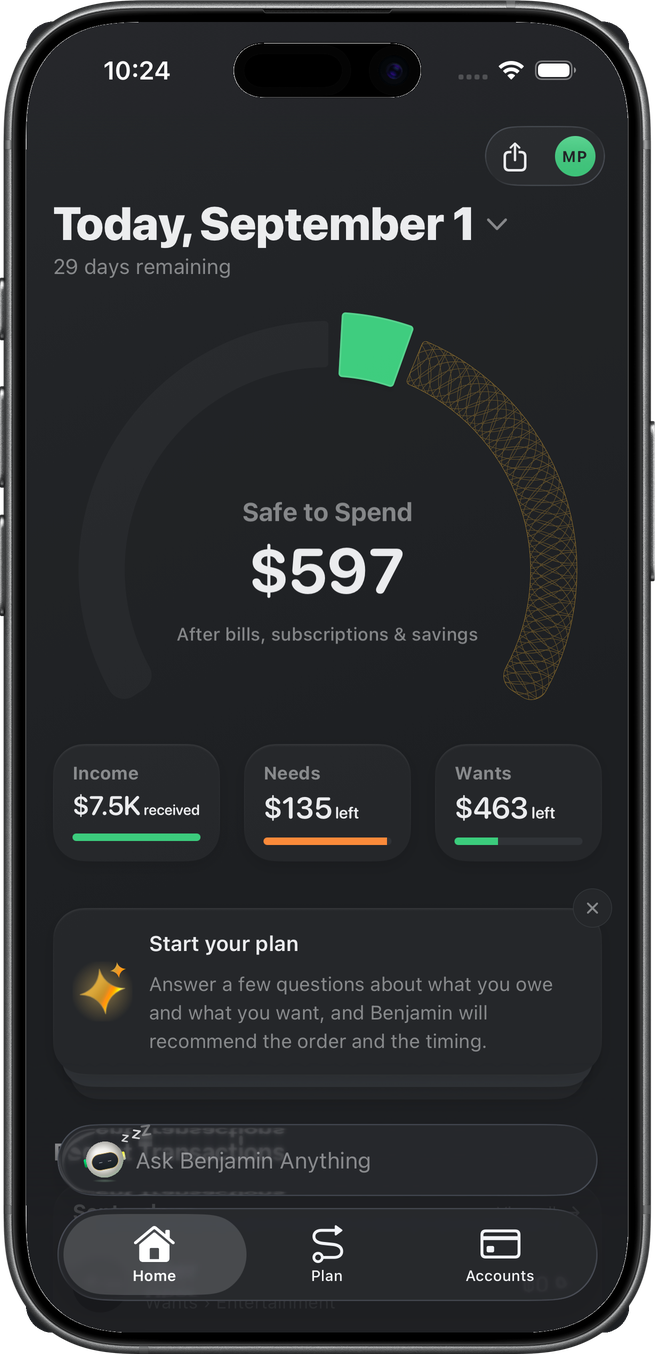
Wellthplan asks nothing. You connect your accounts, answer seven questions, and from then on the answer to the only question that matters — what is safe to spend today? — shows up where you already are: on your home screen, in a text from Benjamin, in the family plan you share.
What the matrix actually says
Seventy-four rows is a lot of checkmarks, so here is the honest summary.
Where we are alone. Nobody else has a household as the unit of design. Monarch added "yours, mine and ours" labels last fall, and YNAB lets six people share one subscription — but in both, it is still one person's plan with guests. Wellthplan's shared plans, SMS member invites, and the expense splitting and multi-space organisations on our roadmap treat the household as the customer. The same is true of the channel: we are the only app on the board that talks to you over iMessage and SMS, and reads your bank's own alert emails, rather than waiting for a tap.
We are also alone on the things that make "passive" work: a single Safe to Spend number instead of a budget to reconcile; a Needs / Wants / Savings model that turns raw transactions into three numbers anyone can act on; a guided plan that goes past budgeting into the emergency fund, debt, life insurance, a will, retirement; and The Rundown, a swipeable weekly and monthly story of your money, hosted by Benjamin. Conversational onboarding, charts you can simply ask for, a geo-tagged map of your spending and the Wellth Score round it out.

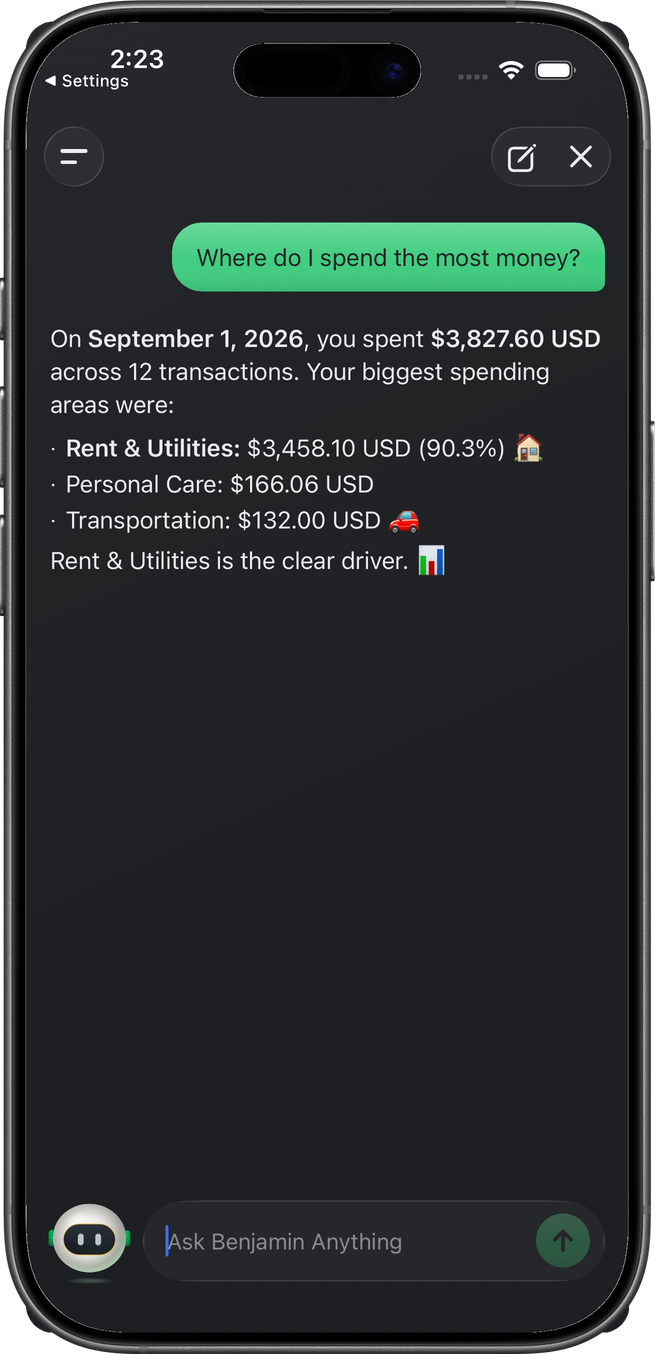
Where we are at parity. Bank linking, categorisation, custom rules, net worth, subscriptions and bills, goals, cashflow and Sankey views — the table stakes — we have, and so does everyone worth comparing to. A year ago we would have listed receipt scanning and an AI assistant as unique. Monarch shipped both last December, and push notifications now ride alongside our text and email alerts. Good. Table stakes should move.
We will never chase the banking rails, though: credit scores, cash advances, high-yield savings and debit cards are Rocket's, Cleo's and Albert's game. If those are the reason you pick an app, they are better picks than us, and we would rather say so.
The most interesting thing that happened this year
On August 25, Rocket Money launched Rowan: an AI agent, built with Anthropic, that lives in your text messages, watches your spending around the clock, and acts when you reply with one word. Cancel. Negotiate. Round up my coffees. It is part of a new Premium+ tier at $15 a month.
We think Rowan is the most important product launch in this category in years, and not because it competes with us — though it does. It matters because it is the first time a large player has said, in public, what we have been saying since day one: the dashboard was the problem. People will pay for an agent that reaches out first and does the work. Rocket's own launch post puts it plainly: "Most personal finance apps are passive, they show you a dashboard and leave the real work up to you."
Rowan and Benjamin agree on the medium — the text thread you already live in. They disagree on the unit. Rowan optimises one person's bills. Benjamin keeps a household on the same page: what's committed, what's flexible, what's yours, for everyone who shares the money. That difference is not a feature. It is an architecture, and it is the one thing on the matrix we do not expect anyone to copy quickly.
About the price
Monarch Plus is $199 a year. Rocket Premium+ is $15 a month, $180 a year. YNAB is $109. Cleo's full toolkit is $14.99 a month. Wellthplan Core is $99.99 a year, or $14.99 a month. Wellthplan Pro is $199.99 a year, or $24.99 a month. Both come with a 14-day trial.
We know Pro is the top of the range. It is also the only price on this list that includes the whole household, the agent, and every feature — no add-ons, no Plus, no Premium+. Two straightforward plans, and the one built for couples covers the people who actually manage money together.
What we are doing with this
The matrix is not a marketing document; it is how Benjamin, our engineering agent, now spends part of every weekday morning — checking competitor changelogs and pricing pages, scoring our feature checklist against what he can actually source, and telling us on Sundays where we lead, where we lag, and the one thing to do next. This week's answer was budget rollover. We are moving it up.
If you want a beautiful dashboard, get Monarch. If you want a method, YNAB will change you. If you want your bills negotiated, Rocket does it for real.
If you want to stop thinking about money — and you do not do that alone — that is what we built.